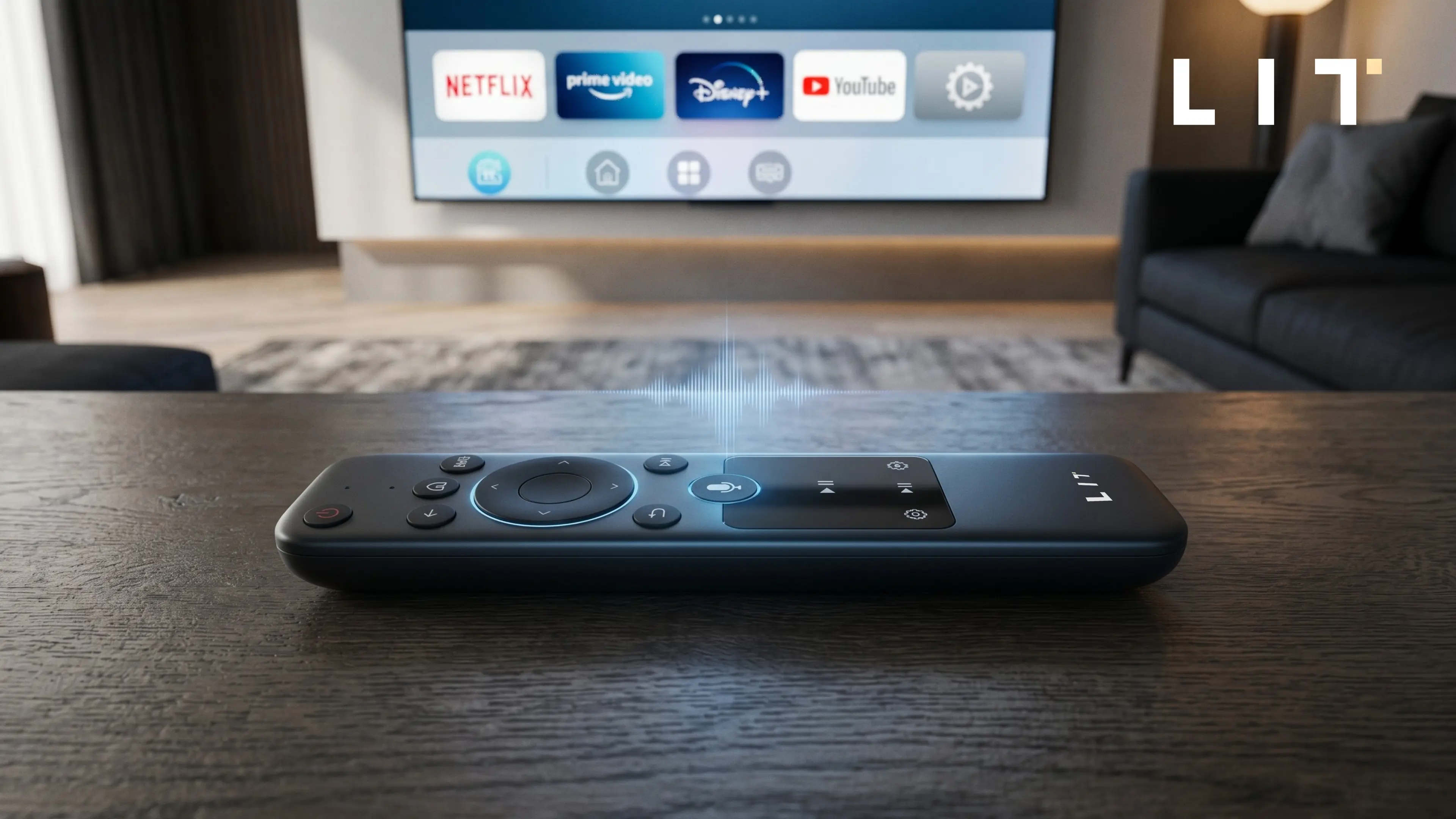
The remote control is no longer a passive accessory. It has become a primary interface between users and increasingly complex device ecosystems.
Global smart TV shipments are projected to cross 300 million units annually, and every screen ships with a remote. As these ecosystems grow in complexity, the remote has quietly become the most-touched piece of hardware in a connected home.
As smart TVs, streaming platforms, and connected home devices continue to expand, expectations from a remote have fundamentally changed. This shift is driving demand for smart remote control manufacturing that combines voice input, touch sensitivity, and connected intelligence.
For brands, this evolution is strategic. The remote now directly influences user experience, product differentiation, and long-term customer satisfaction.
What Is a Smart Remote Control?
A smart remote control is a connected, software-enabled device designed to control multiple systems through technologies such as Bluetooth remote control, WiFi remote control, and IoT protocols.
Unlike traditional infrared devices, modern remotes are built as unified control hubs. Key capabilities include:
- Multi-device control across TVs, set-top boxes, HVAC systems, and smart home devices
- Wireless connectivity beyond line-of-sight limitations
- Integration with voice assistants and IoT ecosystems
- Firmware updates and app-based control
- Personalization based on user behavior
For OEM brands, each of these capabilities translates directly into a manufacturing requirement, not just a product feature. These advancements are redefining expectations from remote control manufacturers and pushing innovation in both hardware and software.
Voice Control: From Feature to Standard
Voice control is no longer a premium add-on. It is becoming a baseline requirement in modern remote control systems.
Voice-enabled smart remotes allow users to:
- Search and access content instantly
- Control device functions using natural language
- Integrate with smart home ecosystems
- Improve accessibility and ease of use
From a manufacturing perspective, this requires:
- Advanced microphone integration
- Noise suppression and signal clarity
- Low latency processing
- Compatibility with major voice platforms
For any OEM remote control manufacturer, voice integration is now a critical capability.
Touch Sensitivity and Interface Innovation
Touch-sensitive remotes are reshaping industrial design and usability. Capacitive touch interfaces are enabling more intuitive and flexible control systems.
Key advantages:
- Premium and minimal design
- Reduced mechanical wear
- Customizable interfaces
- Gesture-based navigation
However, user behavior still favors tactile feedback for frequently used functions. Studies consistently show that users prefer physical buttons for power, volume, and mute, even on otherwise touch-first devices. The industry response has been hybrid design.
The industry is moving toward hybrid designs:
- Essential physical buttons
- Touch-enabled navigation surfaces
This approach balances usability with innovation in custom remote control solutions.
Market Trends Driving Smart Remote Growth
The global market for smart remotes is expanding rapidly, driven by ecosystem growth and user expectations.
Key growth drivers:
- Smart TV and OTT adoption
- Expansion of IoT-enabled homes
- Demand for seamless user experiences
- Focus on energy-efficient products
Emerging trends include:
- Solar-powered and battery-efficient remotes
- AI-driven personalization
- Gesture and touch hybrid interfaces
- Multi-device and multi-ecosystem compatibility
These trends are pushing remote control suppliers and manufacturers to innovate beyond traditional designs.
What This Means for OEM Remote Control Manufacturers
The shift toward smart remotes is transforming manufacturing requirements.
1. Advanced Electronics Integration
Smart remotes require compact PCB design, embedded systems, sensors, and wireless modules.
2. End-to-End Manufacturing Capabilities
Brands now prefer partners offering end-to-end remote control manufacturing, from design to final assembly.
3. Faster Time to Market
Rapid prototyping and scalable production are critical for competitive advantage.
4. Quality and Reliability
With increased functionality, maintaining consistent performance at scale is essential.
5. Customization and Flexibility
Demand is rising for custom smart remote control solutions tailored to specific product ecosystems.
Manufacturers that combine OEM, ODM, and EMS capabilities are best positioned to meet these evolving demands.
Conclusion
The remote control is evolving into a smart, connected interface that defines user experience. Voice control, touch sensitivity, and IoT integration are no longer optional features. They are shaping the future of interaction across consumer electronics.
For brands, this presents an opportunity to differentiate through design and functionality. For manufacturers, it marks a shift toward higher-value, innovation-driven production.
Looking for a reliable OEM remote control manufacturer?
Partner with LIT Group, a leading provider of electronics manufacturing services (EMS) and smart remote control manufacturing. With over 30 years of experience, advanced PCB design capabilities, and end-to-end production infrastructure, LIT Group delivers custom remote control solutions tailored to your product needs.
Contact us at contact@litgroup.in to develop your next generation smart remote control.
FAQs
What is a smart remote control?
A smart remote control is a connected device that uses Bluetooth, WiFi, or IoT technologies to control multiple devices and systems with advanced features like voice control and app integration.
What is the difference between IR and smart remote controls?
IR remotes require line-of-sight, while smart remotes use wireless technologies like Bluetooth and WiFi, allowing more flexible and connected control.
What features should brands look for in smart remote manufacturing?
Brands should focus on voice integration, touch interfaces, IoT compatibility, energy efficiency, and scalable manufacturing capabilities.
Why is OEM remote control manufacturing important?
OEM manufacturers help brands design, develop, and produce custom remote controls efficiently, ensuring quality and faster time to market.
How are hybrid smart remotes improving user experience?
Hybrid smart remotes combine physical buttons with touch-sensitive controls, allowing users to maintain tactile feedback for essential functions while benefiting from modern gesture and navigation features.