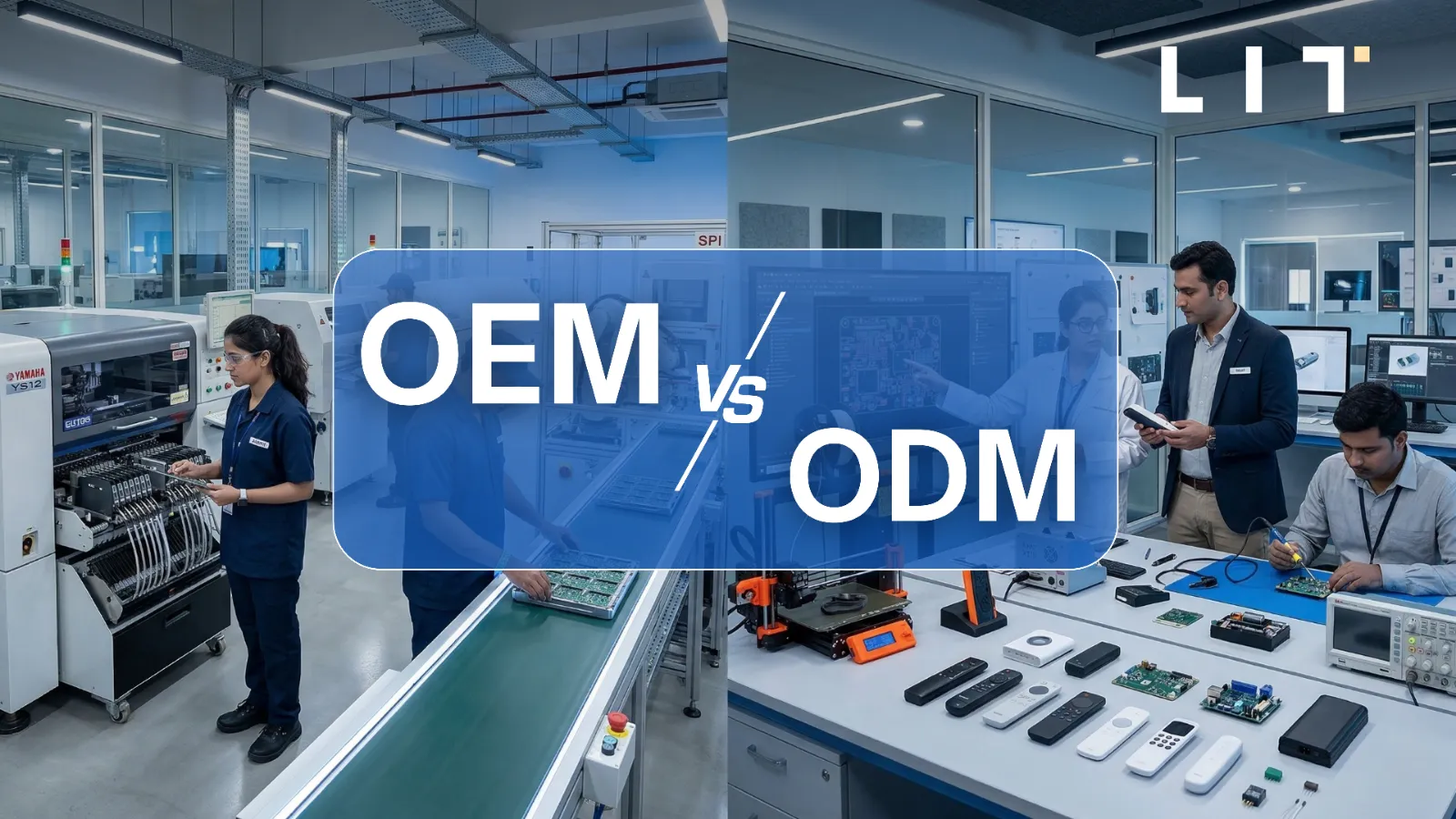
In today’s competitive electronics market, speed, cost efficiency, and product differentiation are critical. Whether you are launching a new Smart TV remote, HVAC controller, or IoT device, your manufacturing model directly impacts your success.
Two of the most widely used models are OEM (Original Equipment Manufacturer) and ODM (Original Design Manufacturer). While both involve outsourcing production, the level of control, customization, and investment differs significantly.
Choosing the wrong model can lead to delays, higher costs, or limited product differentiation. Choosing the right one can accelerate time-to-market and improve margins.
This guide breaks down OEM vs ODM in a practical, decision-focused way, helping you select the right approach for your product and business goals.
What Is OEM Manufacturing?
OEM stands for Original Equipment Manufacturer. In this model, you design the product, and the manufacturer builds it according to your specifications.
How OEM Works
- You own the product concept, design, and IP
- You provide detailed specifications such as PCB design, firmware, and industrial design
- The manufacturer handles production, assembly, and quality control
- The final product carries your brand name
Example in Electronics
A brand designing a custom Bluetooth voice remote for its Smart TV ecosystem would typically use OEM. The brand defines:
- Button layout and UX
- Connectivity protocols
- Firmware and voice integration
- Industrial design
The manufacturer executes production at scale.
Benefits of OEM
- Full control over design and features
- Strong brand differentiation
- Ownership of intellectual property
- Flexibility to innovate
Limitations
- Higher upfront investment in R&D and tooling
- Longer development cycles
- Requires strong technical expertise
When OEM Makes Sense
- You want a unique product in the market
- You have in-house design or engineering capabilities
- Your product is central to your brand identity
What Is ODM Manufacturing?
ODM stands for Original Design Manufacturer. In this model, the manufacturer designs and produces the product, and you sell it under your brand.
How ODM Works
- The manufacturer develops a ready-made or semi-custom product
- You select a design from their portfolio
- Minor customizations like branding, UI, or features may be possible
- The product is rebranded and sold under your name
Example in Electronics
A company launching a standard set-top box remote or basic HVAC remote may choose ODM. The manufacturer already has a proven design that can be quickly adapted.
Benefits of ODM
- Faster time to market
- Lower development cost
- Reduced technical involvement
- Proven designs with lower risk
Limitations
- Limited customization
- Less product differentiation
- Shared designs may be used by multiple brands
When ODM Makes Sense
- You need to launch quickly
- Budget constraints limit R&D investment
- The product is not a core differentiator
- You are testing a new market segment
Key Differences: OEM vs ODM at a Glance
| Factor | OEM | ODM |
|---|---|---|
| Product Design | Owned by brand | Owned by manufacturer |
| Customization | High | Limited |
| Time to Market | Longer | Faster |
| Investment | Higher | Lower |
| IP Ownership | Brand | Manufacturer |
| Differentiation | Strong | Moderate to low |
Simple rule:
If you want control and uniqueness, go OEM.
If you want speed and cost efficiency, go ODM.
When Should You Choose OEM?
OEM is the right choice when your product plays a strategic role in your brand ecosystem.
Choose OEM if:
1. You Need Product Differentiation
For products like smart remotes, IoT controllers, or premium electronics, differentiation matters. OEM allows you to build unique features such as:
- Voice control integration
- Multi-device control
- Custom UI and ergonomics
2. You Have Long-Term Product Vision
OEM supports scalable product roadmaps where future upgrades and compatibility are important.
3. You Want Full Control Over Quality and Features
Every detail, from PCB layout to button feedback, can be tailored.
4. You Are Building a Premium Brand
High-end brands rely on proprietary designs to stand out.
Example Scenario:
A Smart TV brand developing a voice-enabled Bluetooth remote with Google Assistant integration would benefit from OEM. The product becomes part of the brand’s identity and ecosystem.
When Should You Choose ODM?
ODM is ideal for speed-driven or cost-sensitive product launches.
Choose ODM if:
1. Time to Market Is Critical
ODM enables quick deployment using ready-made designs.
2. You Are Entering a New Category
You can test demand without heavy investment.
3. The Product Is Not Core to Your Brand
For accessories or secondary products, ODM is efficient.
4. You Want Lower Risk
Proven designs reduce development uncertainties.
Example Scenario:
A DTH operator launching a basic remote control for millions of users would prefer ODM. The focus is reliability and cost efficiency, not customization.
Real-World Examples: Air Conditioner Controller
Understanding how OEM and ODM apply in real use cases helps make the decision clearer.
HVAC Remote Controls
- OEM Approach: Brands designing advanced remotes with features like BLE, backlit buttons, sensor-based temperature control, or smart connectivity.
- ODM Approach: Standard remotes for air conditioners with minimal differentiation and high volume requirements.
Insight:
High-volume, low-complexity products lean toward ODM.
Feature-rich, ecosystem-driven products lean toward OEM.
OEM vs ODM Decision Matrix
Use this quick matrix to decide which model fits your requirements:
| Requirement | OEM | ODM |
|---|---|---|
| High customization | ✓ | |
| Fast launch timeline | ✓ | |
| Limited budget | ✓ | |
| Strong brand differentiation | ✓ | |
| Long-term product roadmap | ✓ | |
| Commodity product | ✓ |
Decision Shortcut
- If your product defines your brand → OEM
- If your product supports your business → ODM
Conclusion
OEM and ODM are not competing models. They are strategic tools.
The right choice depends on your product’s role, your budget, and your timeline. Many successful electronics brands use a hybrid approach, combining OEM for flagship products and ODM for high-volume accessories.
If you are developing remote controls for Smart TVs, HVAC systems, or IoT devices, aligning your manufacturing model with your business goals is critical.
OEM and ODM are choices that shape your product, cost, and speed to market. OEM fits innovation and differentiation, while ODM works best for speed and cost efficiency. Many brands use a mix of both.
If you are developing remote controls for Smart TVs, HVAC systems, or smart devices, choosing the right manufacturing partner is critical.
At LIT Group, we offer end-to-end OEM and ODM solutions with 30+ years of experience, helping brands launch reliable, scalable remote control products.
Looking to build your next remote?
Partner with a trusted remote control manufacturer.
FAQs
1. What is the main difference between OEM and ODM manufacturing?
The main difference lies in product ownership and design control. In OEM manufacturing, the brand designs the product and the manufacturer produces it. In ODM manufacturing, the manufacturer designs the product, and the brand simply rebrands and sells it.
2. Which is better for electronics brands: OEM or ODM?
It depends on your business goal. OEM is better if you need customization and brand differentiation, while ODM is ideal if you want faster time to market and lower costs.
3. Can I customize a product in ODM manufacturing?
Yes, but customization is limited. ODM typically allows changes like branding, minor design tweaks, or feature adjustments, but the core product design remains the same.
4. Is OEM manufacturing more expensive than ODM?
Yes, OEM usually involves higher upfront costs due to product design, R&D, tooling, and testing. However, it offers better long-term value through unique products and stronger brand positioning.
5. Which model is best for remote control manufacturing?
For remote control manufacturing, the choice depends on the product type.
- Use OEM for advanced remotes like Bluetooth, voice-enabled, or smart remotes
- Use ODM for standard remotes like IR-based or basic set-top box remotes