In the rapidly evolving world of consumer electronics, differentiation is the key to market leadership. While the core product—be it a smart TV, a specialized air conditioner, or a complex home automation system—is critical, the user's primary touchpoint is often the remote control. For Electronics OEMs (Original Equipment Manufacturers), a generic, "off-the-shelf" remote is no longer sufficient. To deliver a truly premium user experience and reinforce brand identity, customized remote solutions have become a strategic necessity.
Building a custom remote requires more than just changing a logo. it involves deep engineering, ergonomic design, advanced connectivity, and seamless integration with the end device. Partnering with a specialized remote control manufacturer allows OEMs to transition from basic controllers to sophisticated, brand-aligned interfaces that drive customer satisfaction and loyalty.
This guide explores why customized remote solutions are vital for modern electronics brands and the technical capabilities required to bring these tailored products to market.
Why Customization Matters for Electronics OEMs
For an OEM, the remote control is an extension of the brand. Here’s why customization is a game-changer:
- Enhanced User Experience (UX): Tailored button layouts, intuitive navigation, and ergonomic shapes make the end product easier and more enjoyable to use.
- Brand Consistency: Custom colors, textures, and industrial designs ensure the remote feels like a cohesive part of the brand’s product ecosystem.
- Feature Alignment: Custom remotes allow OEMs to include specific hotkeys (e.g., dedicated streaming buttons for Smart TVs) or specialized functions for industrial or medical equipment.
- Competitive Differentiation: A unique, high-quality remote can be a significant selling point, distinguishing a brand from competitors using generic solutions.
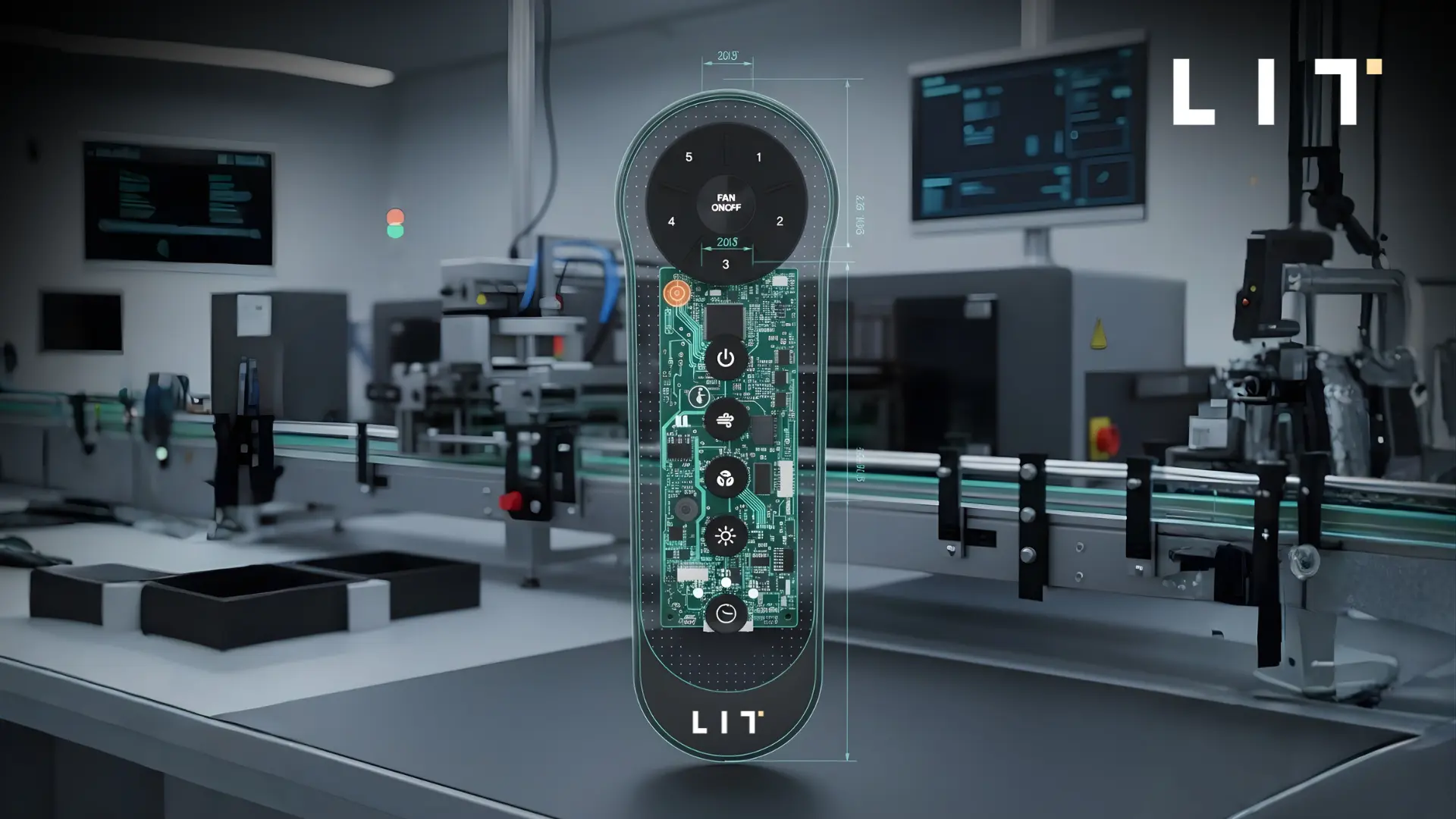
Key Dimensions of Remote Control Customization
True customization for electronics brands spans multiple domains, from aesthetics to core technology.
1. Industrial Design and Ergonomics
The physical "look and feel" is the first thing a user notices. Customization options include:
- Form Factor: Designing unique shapes that are comfortable for long-term use.
- Material Selection: Choosing between various plastics (ABS, PC), soft-touch coatings, or metallic finishes to match product positioning.
- Tactile Feedback: Tuning the "click" feel of buttons using different silicone rubber grades or metal domes to meet specific user preferences.
2. Advanced Connectivity Technologies
Electronics OEMs require different communication protocols depending on the application:
- Infrared (IR): The standard for cost-effective, line-of-sight control.
- Radio Frequency (RF): Ideal for non-line-of-sight operation and long-range applications.
- Bluetooth Low Energy (BLE): Enabling bi-directional communication, voice control, and smartphone integration.
- Voice Control: Integrating high-quality microphones and voice processing for modern smart devices.
3. Proprietary Firmware and Software
The "intelligence" of the remote is customized through firmware:
- Custom Code Sets: Ensuring compatibility with proprietary device protocols.
- Multi-Device Pairing: Enabling a single custom remote to control multiple components of a brand’s ecosystem.
- Power Optimization: Developing custom sleep and wake cycles to maximize battery life.
4. Aesthetic and Functional Customization
- Backlighting: Adding LED backlighting for ease of use in dark environments.
- Display Integration: Including LCD or OLED screens for status updates or complex menu navigation.
- Branding: Custom laser marking, pad printing, or embossed logos.
The Full-Lifecycle Customization Process
A reliable EMS (Electronic Manufacturing Services) partner supports OEMs through a structured development process:
- Requirements Analysis: Understanding the brand's vision, target user, and technical specifications.
- Concept and Design: Creating industrial designs and electronic schematics tailored to those requirements.
- Prototyping: Producing 3D-printed housings and functional PCBs for testing and validation.
- Tooling and Moulding: Developing high-precision injection moulds for the custom housing.
- Mass Production: Leveraging high-speed SMT lines and automated assembly for consistent quality at scale.
Choosing the Right Manufacturing Partner for Custom Solutions
For electronics OEMs, the choice of a manufacturing partner is critical. Look for:
- Deep Engineering Expertise: A partner that understands both the electronic and mechanical aspects of remote design.
- In-House Capabilities: Integrated design, tooling, SMT assembly, and moulding reduce lead times and improve quality control.
- Quality Certifications: Adherence to ISO standards ensures that custom products are reliable and durable.
- Scalability: The ability to support both specialized niche projects and high-volume global launches.
How LIT India Pvt. Ltd. Empowers Electronics OEMs
LIT India is a leading remote control manufacturer in India, specializing in delivering high-performance, customized remote solutions for global brands.
With over 30 years of experience and a complete in-house manufacturing ecosystem, we offer:
- End-to-End OEM/ODM Services: From initial concept to final box-build.
- Advanced Technology Integration: Expertise in IR, RF, BLE, and voice-enabled solutions.
- Precision Manufacturing: State-of-the-art SMT assembly and injection moulding.
- Brand-Centric Customization: Helping brands build products that are truly their own.
Conclusion
Customized remote solutions are no longer a luxury; they are a critical component of a successful electronics brand's strategy. By focusing on tailored design, advanced technology, and high-quality manufacturing, OEMs can deliver superior user experiences and build stronger brands.
Partner with LIT India to build a remote control that reflects your brand's excellence.
Contact us today at contact@litgroup.in to start your custom remote project.